Sample report · No login needed
Camera lens imported from the USA: HS code, duty and compliance
This is a real EximSetu report, run on 25 Sept 2026 from one product photo. Below is the whole conversation: the questions EximSetu asked, the answers given, and the full report. Only a one-line status note at the top of the final answer has been removed.
Get this report for your own product
Upload a photo, answer a few questions, and get the HS code, duty, FTA, import policy and compliance checklist.
Try 1 free lookup →No credit card required · 1 free lookup every month
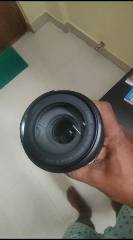
Importing this camera from USA cif price is 320 what will hs code and duty and complaince required
EximSetu asks before it decides
I can see: a Canon EF-S mount interchangeable camera lens (zoom lens, ~18–135mm class, with UV filter ring and lens hood mount) — held in hand, so it appears to be a loose/used item rather than retail-packed.
Before I lock the HS code and duty, four quick questions — each one changes the answer:
- Is this the lens only, or a camera body + lens kit? A standalone lens goes to Chapter 90 (9002), a complete digital camera goes to Chapter 85 (8525) — very different duty.
- Is the CIF 320 in USD or INR? (USD 320 ≈ ₹28,000; that changes the whole duty calculation.)
- Is the lens new or used/second-hand? Used goods have a different import policy (second-hand goods are generally Restricted and need a DGFT licence), plus valuation via a Chartered Engineer's certificate.
- How is it coming in — commercial import on your IEC, a courier/post shipment, or in personal baggage as accompanied luggage? Baggage rules and duty treatment differ completely from a commercial bill of entry.
Also useful if you know it: whether it's shipped as a repair/return item (re-import of an Indian-origin lens sent abroad for servicing attracts a concessional notification).
this is lens only , 320 usd , new , commercial Import on iec
Full report
Product: One new Canon EF-S mount interchangeable zoom camera lens (mounted glass objective lens with autofocus motor), imported separately from the camera body — commercial import on IEC, CIF USD 320/unit.
Suggested ITC-HS code: 9002 11 00 — Lenses, prisms, mirrors and other optical elements, mounted, being parts of or fittings for instruments or apparatus — Objective lenses: For cameras, projectors or photographic enlargers or reducers
Confidence: High — a mounted photographic objective lens imported on its own is the textbook entry for 9002 11 00; the only real variable is whether it ships packed together with a camera body.
Why this code:
- GRI 1 decides it: the heading text of 9002 covers mounted optical elements that are parts/fittings for instruments. Your lens is a finished, mounted assembly with a bayonet mount, focus/zoom mechanism and AF motor — not loose glass.
- Chapter 90, Note 1 and Note 2(a)/(b): parts and accessories that are goods included in any heading of Chapter 90 are classified in their own heading. A camera objective lens has its own heading (9002), so it does not go to a "parts of cameras" residual heading.
- At subheading level, GRI 6 + the 9002 11 text ("for cameras") puts it in 9002 11 00 rather than 9002 19 00 (other objective lenses, e.g. microscope/telescope objectives).
Close alternatives and what would push it there:
| Code | When it would apply instead |
|---|---|
| 9001 90 00 | Unmounted lens elements / raw optical glass blanks — no barrel, no mount |
| 8525 89 00 | If the lens is shipped with a camera body as a kit — GRI 3(b), the camera gives essential character, whole thing is a digital camera |
| 9002 19 00 | Objective lenses not for cameras/projectors (microscope, telescope, machine-vision) |
| 9006 91 00 | Camera parts/accessories that are not optical elements — lens caps, hoods, adapters, filters holders sold separately |
| 8529 90 90 | Lenses specifically for television cameras built into broadcast/CCTV apparatus (argued occasionally; Chapter 90 generally prevails for standalone photographic objectives) |
⚠️ Origin flag: you have stated country of origin = USA, but Canon EF-S lenses are typically manufactured in Japan, Taiwan, Malaysia or Thailand. Country of origin = where manufactured, not where shipped from. Check the "Made in ___" marking on the barrel/box and declare that on the Bill of Entry. Declaring the wrong origin is a misdeclaration under Section 46 even when the duty rate is identical.
Duty estimate (import) — 1 unit, CIF USD 320
Assessable value = CIF (the 1% landing charge loading was removed w.e.f. 2017). Exchange rate must be the CBIC-notified rate on the date of filing the Bill of Entry — I have used ₹88/USD as an illustration only.
AV = 320 × 88 = ₹28,160
| Levy | Rate | Calculation | Amount (₹) |
|---|---|---|---|
| Basic Customs Duty (BCD) | 10% (to be verified) | 10% × 28,160 | 2,816.00 |
| AIDC | Nil | — | 0.00 |
| Social Welfare Surcharge | 10% of BCD | 10% × 2,816 | 281.60 |
| Value for IGST | — | 28,160 + 2,816 + 281.60 | 31,257.60 |
| IGST | 18% (to be verified) | 18% × 31,257.60 | 5,626.37 |
| Compensation Cess | Nil | — | 0.00 |
| Anti-dumping / Safeguard | None known on 9002 | — | 0.00 |
| Total duty payable | ₹8,723.97 | ||
| Landed cost | 28,160 + 8,724 | ₹36,884 |
- Effective duty incidence ≈ 30.98% of CIF.
- Real cash cost is lower: IGST of ₹5,626 is fully creditable as input tax credit against your GST output liability. Your non-recoverable duty is only BCD + SWS = ₹3,097.60 (≈11% of CIF).
- Verify before filing: BCD and IGST rates on the ICEGATE duty calculator (icegate.gov.in/cdc) for CTH 90021100, and the CBIC exchange rate notification for the week of clearance. Rates change every Budget — do not file on my figures alone.
- Valuation risk: USD 320 for a Canon EF-S zoom is plausible but customs will run it against NIDB contemporaneous data. Carry the manufacturer/dealer invoice, proof of payment (bank remittance/SWIFT) and a price list. If you are buying from a related party (Canon group entity or your own affiliate), SVB registration under CBIC Circular 5/2016 is triggered.
FTA benefit: None available. India has no free trade agreement or preferential tariff arrangement with the United States. MFN rate applies, no Certificate of Origin needed for rate purposes. Note the flip side of the origin point above — if the lens is actually Japanese-origin, the India–Japan CEPA could give a reduced or nil BCD, but you would need an original Form JCEPA Certificate of Origin issued by the Japanese Chamber of Commerce, and goods shipped via a US intermediary must satisfy the direct-consignment rule (through-B/L or non-manipulation certificate from US customs). A US-sourced second-hand-market purchase will normally not be able to produce a valid CoO, so plan on the MFN rate.
Import policy: FREE. CTH 9002 11 00 is freely importable under Schedule I of the ITC(HS) Import Policy. No DGFT licence, no authorisation required for new goods. (Had this been used/second-hand, it would fall under the "second-hand goods" restriction in Para 2.31 of the Foreign Trade Policy and needed a DGFT import authorisation + Chartered Engineer certificate — you have confirmed it is new, so this does not apply.)
Compliance checklist
| Requirement | Status | What you need to do |
|---|---|---|
| IEC + GSTIN + AD Code registration | 🔴 Mandatory | Valid IEC from DGFT, GSTIN linked in ICEGATE, AD Code of your bank registered at the port of import. Must be done before the shipment lands. |
| Bill of Entry + supporting documents | 🔴 Mandatory | File BoE on ICEGATE through your CHA with commercial invoice, packing list, Bill of Lading/AWB, insurance certificate and declaration of correct country of origin (CAROTAR declaration if any preference is claimed). |
| Country-of-origin declaration (Section 46 / CAROTAR 2020) | 🔴 Mandatory | Declare the actual manufacturing country from the product marking, not the shipping country. Keep the origin evidence on file for 5 years. |
| Legal Metrology (Packaged Commodities) Rules, 2011 | 🟠 Check | Applies if the lens is a pre-packaged retail unit. You need an LMPC importer registration (Rule 27) from the Controller of Legal Metrology of your State, and the package must declare importer name/address, country of origin, MRP, net quantity, month/year of import and customer care details — stickers must be affixed before customs clearance, not after. Not applicable if imported as a bare/bulk item for institutional or captive use. |
| E-Waste (Management) Rules, 2022 — EPR registration | 🟠 Check | Verify whether camera lenses fall within the Schedule I EEE codes (camera bodies do; motorised lens assemblies are borderline). If covered, the importer is the "producer" and must obtain EPR registration from CPCB before import. Get a written confirmation from CPCB or your consultant — customs has been asking for EPR numbers on electronics BoEs. |
| Plastic Packaging EPR (PWM Rules, 2016 as amended) | 🟠 Check | Triggered by the plastic packaging the lens arrives in, not the lens itself, and only once you cross the importer thresholds. Register on the CPCB EPR portal if applicable. |
| SVB (Special Valuation Branch) reference | 🟠 Check | Only if buyer and seller are related parties, or if there is a royalty/licence fee tied to the import. If unrelated arm's-length purchase, ignore. |
| Product / brand authorisation (IPR — Canon trademark) | 🟠 Check | If Canon India has recorded its trademark under the IPR (Imported Goods) Enforcement Rules, 2007, a parallel/grey-market import can be detained. Carry proof of genuine sourcing from an authorised Canon channel. |
| BIS CRS (MeitY Compulsory Registration Order) | 🟢 Not required | A standalone optical lens is not a listed product under the CRS schedule. Note: a digital camera body is a different matter — if you later import bodies, check the CRS list before shipping. |
| WPC / ETA (wireless equipment approval) | 🟢 Not required | No radio transmitter, Wi-Fi or Bluetooth in an EF-S lens. Would become 🔴 for lenses or cameras with built-in Wi-Fi/BT. |
| Lithium battery / DG shipping (UN 38.3, IATA PI 965/967) | 🟢 Not required | The lens contains no battery. Would apply if a camera body or spare battery is shipped with it. |
| FSSAI / CDSCO / Plant Quarantine / Wildlife NOC | 🟢 Not required | Not a food, drug, medical device, plant or wildlife product — no cross-clearance from any other agency. |
🔴 Mandatory · 🟠 Check · 🟢 Not required
Practical notes
- Confirmed vs. general knowledge: The HS classification (9002 11 00) and the import policy status (Free) are from the tariff structure and are reliable. The BCD 10% and IGST 18% are from my general knowledge of the current tariff — I was not able to verify them against a live CBIC source in this session, so treat them as indicative and have your CHA confirm on ICEGATE before you file.
- Courier vs. cargo: At USD 320 for a single unit, air courier is likely. Commercial imports through courier on an IEC are allowed under the Courier Imports and Exports Regulations, but the courier must file a Courier Bill of Entry (CBE-XI) in your IEC, not clear it as a gift or sample. Insist on this in writing — otherwise you lose the IGST credit.
- Do not let the shipper declare it as a "gift" or under-value it. Gift imports above ₹5,000 (₹50,000 in specified cases) attract full duty plus confiscation risk under Section 111(m), and you cannot claim ITC without a proper BoE in your GSTIN.
⚠️ This is a suggested classification. Please verify with your customs broker, or apply for an Advance Ruling (CAAR) for certainty.
Get this report for your own product
Upload a photo, answer a few questions, and get the HS code, duty, FTA, import policy and compliance checklist.
Try 1 free lookup →No credit card required · 1 free lookup every month
Sample shown for illustration. Rates in this report were from the AI's general knowledge and marked for verification, and tariffs change with Budgets and notifications, so don't rely on these figures for your own filing. EximSetu gives a suggested classification; confirm with your customs broker before filing.